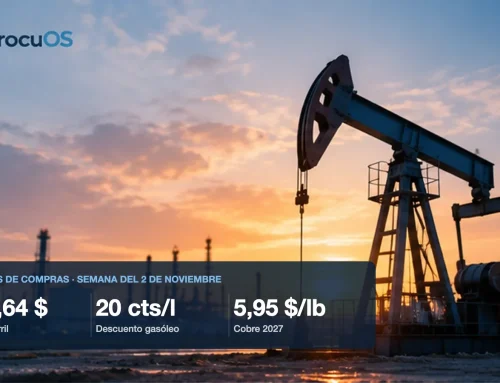

Oil has fallen sharply in two weeks, but diesel and your suppliers’ prices have not felt it the same way. In Spain, October CPI is confirmed at 4.9% and the 20-cent fuel discount holds until the end of the year. In Europe, Germany ratifies the agreement with Mercosur. And in Latin America, Peru raises rates while Mexico and Brazil show that part of their October inflation is a one-off.
The week in 8 figures
| Indicator | Figure | Trend | Where you’ll feel it |
|---|---|---|---|
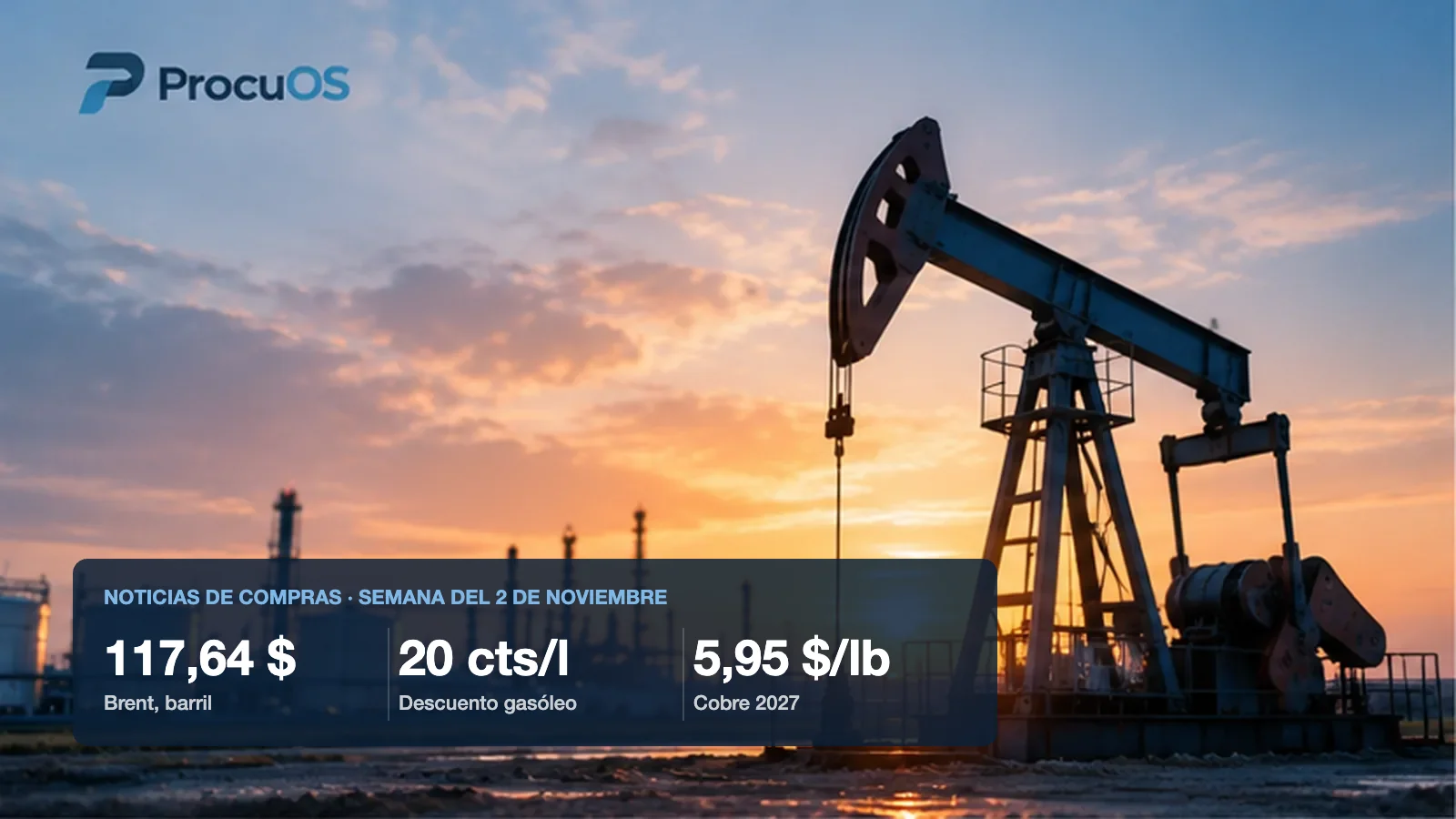
| Brent crude | US$95.84/barrel (13/11) | ▼ −18.5% since the end of October | Plastics, chemicals, resins, packaging |
| Diesel (Spain, average) | €1.898/l, about US$2.09 (3-9/11) | = stable | Road freight fuel surcharges |
| Shanghai–Rotterdam freight (40 ft) | US$3,504 (12/11) | ▼ −3% | Imports from Asia (Genoa, stable at US$4,168) |
| Spain CPI (October, final) | 4.9% · core 3.1% | = | Renewals of CPI-linked contracts |
| ECB rates (deposit) | 2.50% | = (next meeting 17/12) | Cost of financing stock and payment terms |
| Copper (weekly close) | US$6.17/lb (13/11) | ▼ −2.47% on the week | Cables, electrical equipment, motors, HVAC |
| US dollar / Mexican peso | 18.53 pesos (13/11) | ▼ dollar −0.51% on the week | Dollar purchases from Mexico |
| Peru policy rate | 4.50% (12/11) | ▲ +0.25 points | Payment terms and supplier prices in Peru |
Data from the sources listed at the end of the article. Dollar equivalents at the ECB reference rate of 17 November (€1 = US$1.0989).
1. Brent falls 18% in two weeks, but diesel barely moves
What happened. The Brent barrel (January delivery) closed on Friday 13 November at US$95.84, 18.5% below the US$117.64 close at the end of October. The International Energy Agency (IEA) sees the first surplus since the start of the war with Iran: global inventories up 52 million barrels in October, the first increase since June. European diesel, by contrast, has fallen only 11% and remains close to US$180 per barrel, 77% above pre-war levels.
Why it matters: this is where this quarter’s money is. Plastics, chemicals and packaging went up “because of crude”: ask this week for a downward revision, in writing and with a date. If the supplier argues the cost reaches them with a delay, ask what delay they applied when prices went up. Don’t expect cuts in transport: your haulage depends on diesel, not crude.
2. Asia–Europe freight keeps falling
What happened. Drewry’s index for 12 November fell 2%, to US$4,305 per 40-foot container. Shanghai–Rotterdam fell 3%, to US$3,504 (4.9% less than on 29 October), and Shanghai–Genoa held at US$4,168.
Why it matters: the market does not support general increases from your freight forwarder for November or December. Reject them and propose, for 2027, a rate indexed to the Drewry index for your route with a monthly review.
3. Spain’s INE confirms October CPI: 4.9%, with core at 3.1%
What happened. The final figure, published on 13 November, confirms the flash estimate: inflation of 4.9%, core inflation of 3.1% and a monthly rise of 0.6%. Funcas expects the rate to fall to 4.6% in November and December.
Why it matters: in December and January renewals with a CPI clause, the supplier will apply 4.9% if the contract doesn’t specify otherwise. Where energy weighs little, the reasonable reference is core inflation (3.1%). And if the review falls in January, ask for the latest published figure to be used, not October’s.
4. Spain’s 20-cent fuel discount continues in December, but ends on the 31st
What happened. Because diesel rose 36% year on year in October and petrol almost 21%, above the 15% threshold set by the royal decree, the discount of 20 euro cents per litre (about US$0.22) stays in full in December. The measure ends on 31 December 2026 and the rule does not provide for an automatic extension into 2027.
Why it matters: December does not justify any increase in the fuel surcharge. The risk is in January: if the discount is not extended, the price per litre may jump by up to 20 cents because of taxes, not the market. Agree now with your hauliers that this jump will be applied through the surcharge formula (litres per trip times the price difference), not as a general rate increase. As a reference, for a truck that uses 32 litres per 100 km, 20 cents means €6.40 per 100 km (about US$7.03).
5. Germany ratifies the EU–Mercosur agreement
What happened. On 13 November the German Parliament approved the law ratifying the agreement with Argentina, Brazil, Paraguay and Uruguay. The trade part has applied provisionally since 1 May 2026 with the bloc’s countries that have already ratified it, with gradual tariff cuts. The opinion of the Court of Justice of the EU is still pending and could take until early 2028.
Why it matters: if you buy from Mercosur suppliers, check in your latest imports whether the preferential tariff is being applied. For that, the supplier has to give you the correct proof of origin; without it you pay the full tariff. Also check the reduction schedule for each tariff code: it changes every year. The same applies if you buy in Mercosur from European suppliers.
6. Peru raises rates for the first time in 14 months: 4.50%
What happened. On 12 November the Central Reserve Bank of Peru raised its policy rate by 25 basis points, to 4.50%. Annual inflation went from 4.5% in September to 5.3% in October, driven by food, energy and El Niño. Excluding food, energy and transport, inflation is 2.0%, in the middle of the target range.
Why it matters: get ready for increases “because of inflation” and for requests to shorten payment terms. On increases: if your supplier doesn’t sell food or energy, its inflation is closer to 2% than to 5.3%. On payment terms, don’t give away days without a discount (see the worked example).
7. Mexico and Brazil: October inflation has small print
What happened. In Mexico, INEGI reported on 9 November annual inflation of 3.75% with a monthly rise of 0.65%. A third of that rise is electricity (+18.51% in the month) due to the end of the summer subsidy; core inflation stands at 3.80%. Banxico cut rates at the start of the month to 6.25% and signals a long pause. In Brazil, the IPCA rose only 0.14% in October (4.63% over twelve months), below the 0.25% expected; transport and housing fell, but food and beverages rose 1.04%.
Why it matters: in Mexico, don’t accept price reviews built on October’s 0.65% monthly figure: it’s a seasonal effect of the electricity tariff. Use annual core inflation (3.80%) as the reference ceiling for products and services without a significant electricity component. In Brazil, the pressure is in food: outside food and agriculture, the figure does not justify increases.
What to do this week: procurement checklist
- Ask in writing for the downward revision of plastics, chemicals and packaging that went up “because of crude” (all regions).
- Reject general increases from your freight forwarder on Asia–Europe and propose for 2027 a rate indexed to the Drewry index for your route.
- In CPI-linked renewals, negotiate with core inflation (3.1%) or the latest published figure, not 4.9% (Spain).
- Agree now how the possible end of the 20-cent discount will be applied in January: through the surcharge formula, not as a rate increase (Spain).
- Check that your Mercosur purchases carry the preferential tariff and ask for the proof of origin (Spain and Mercosur).
- Don’t give away payment days without a discount and calculate their annual rate before negotiating (Peru and all regions).
Worked example: what is an early payment discount really worth?
A supplier offers you a 1% discount if you pay at 30 days instead of 60. Convert it to an annual rate: discount / (1 − discount) × 365 / days you pay early.
0.01 / 0.99 × 365 / 30 = 12.3% a year. If the discount were 2%, the rate would be 24.8% a year.
In money terms, on an invoice of €100,000 (about US$110,000): the discount saves you €1,000 (about US$1,100). Paying €99,000 (about US$108,800) 30 days earlier, if your funding costs 4.5% a year (use your own), costs you 99,000 × 4.5% × 30 / 365 = €366 (about US$400). You gain €634 (about US$700) on every invoice.
Net gain: €634 per invoice, a 12.3% annual return against a 4.5% cost.
The rule works the other way too: if a supplier asks you to move from 60 to 30 days without a discount, they are asking you for a free loan. Ask at least for a discount that matches your cost of money: at 4.5% a year, about 0.37 points for every 30 days (4.5% × 30 / 365). With rates rising, as in Peru, that figure goes up. Always calculate the annual rate before giving or asking for days.
Dates for your diary
- Monday 23 November: next edition of this news.
- Sunday 29 November: OPEC+ meeting, expected to set 2027 production quotas.
- Thursday 17 December: ECB meeting (deposit rate at 2.50%).
- Thursday 31 December: the 20-cent fuel discount ends in Spain, with no extension planned.

Our take
This week you shouldn’t ask for a price cut: you should ask for a formula. Brent has fallen 18%, but the war with Iran is not over and diesel is still 77% above pre-conflict levels. Winning a 5% cut today is a victory the supplier takes back in January, because the contract still has no rule. A good buyer uses the one moment when the supplier will accept changing the mechanism, which is when it has to give money back: the weight of energy in the cost, a public index, a lag of one or two months, a minimum band so you don’t review for cents, and a price that moves up and down on its own. A supplier who accepts a formula to go up but not to go down has just given you a data point for your next tender. You recover a price cut once; a formula pays every month.
To negotiate like this you need to know which contracts went up, when and with what argument, something that gets lost between versions of a spreadsheet. In ProcuOS you have it in one place: management tools to track prices and conditions, supplier management to know who honours their formulas, and electronic negotiation to put the price back into competition when they don’t.
Have a good week, and may every increase this year already have its formula to come down.
— The ProcuOS team
Request a ProcuOS demoWe’ll show you how to build a price review formula with a real contract from your company.
Missed the last one? Read the previous edition of Procurement News.
Was this useful? Share it on LinkedIn or forward it to someone on your team.
Sources
- Brent: Infobae / EFE, 13 November
- IEA, inventories and diesel: Invezz, 13 November
- Freight (Drewry): Shipping Telegraph, 13 November
- Spain CPI: INE · Que!, 15 November
- Fuel discount: El Independiente, 13 November
- Diesel in Spain (EU Oil Bulletin): Cadena de Suministro
- ECB: Rankia, 29 October · Rankia, next meeting
- EU–Mercosur: Infobae / EFE, 13 November · MercoPress, 11 November
- Peru: Infobae / EFE, 13 November
- Mexico: El Contribuyente, 9 November · El Financiero (Banxico) · El Financiero (exchange rate), 13 November
- Brazil: InfoMoney, 12 November
- Copper: Energiminas / Cochilco, 13 November
- OPEC+: Engineering News / Reuters, 2 November